Showing posts with label Art Facilitation. Show all posts

Friday, August 12, 2016

Processes: The playful element in creativity - importance of “Playing”


Sometimes, in my workshops, I use the phrase: the playful element in creativity or try being playful. So what do I mean by that?

Do you remember how you played on the beach, ran your hands through the sand to make patterns, splashed the water or played in the park, running, jumping and leaping in the wild belief that you could eventually fly. Do you remember pretending and creating needed objects out of discarded junk? What do you remember about playing as a child? Take time to think about it and write down some of your thoughts. Even those of you who “never had a childhood” I bet you had active imaginations creating scenarios, stories and faraway places where you would rather have been.  

Bring out the child.

Each one of us still carries with us the child we once were. There are the memories and the feelings of childhood. Remember the pure joy of play: there was no responsibility: just time and space to play. What were you like as a child? What colours did you like? Or what toys or games did you enjoy? 

We all can remember being:
·         Curious or ashamed
·         Sharing or selfish
·         Playful or earnest
·         Angry or happy
·         Rebellious or submissive
·         … you can add in your words of what you were like

What is play?

Play is an activity which involves either fun or spontaneity; filled with exploration and experimentation; and it might involve chance. As children, risk taking might come more naturally because we didn’t think of the consequences or the outcomes and now being risk averse hampers our ability to let go and ‘play’ again. There is a freedom in play and normally it doesn’t include work. Games and scenarios evolve; some have rules but others are open ended and full of possibilities. There are no mistakes in play or mistakes can be easily remedied in play by add-libbing. Play may involve role playing or use of similes. 

Games and play involves:
·         Either just Yourself
·         Or Yourself and “the other”
·         Or as in creativity Yourself and creative materials

When you come to my creative workshops I want to encourage you to play with different materials and ideas. I hope that you will feel lost in time and space for the few hours you are here with me.  Stepping out of your comfort zone to risk making mistakes, exploring new possibilities, experimenting with what is at hand just like a child would if they were given the chance.

Why is play important?

Some people have forgotten how to play, others never played and still others were not given the opportunity to play with different creative materials. It is important to find your playful child again and it is important to enjoy play and have fun. You control the possibilities and anything goes. Nothing is too wild to try. Play is a form of entertainment and its relaxing.

Play helps your development as you learn new things, new possibilities, and new ways of doing things. Through the playful element you find new inspiration and break through creative blocks. Being too serious is very adult but it doesn’t serve us well to always be the adult. There are times when we need to take ourselves less seriously… and PLAY.

The importance of the playful element in creativity helps you discover or stumble upon new inspiration. So doing “silly” or playful things should be welcomed into your creative experience.

Here are some verbs to inspire playful art:
doodling, scribbling, splashing, spraying, blowing, flicking, cutting, chopping, dotting, gluing, creating coloured dust, mixing, shaping, colouring, grading, layering, finger-painting, making marks and more.

Play is joyful, peaceful and soulful.  It fosters relaxation. In creativity new seeds of inspiration emerge through play and per chance it becomes something new and unintended. Similes are seen. Metaphors are observed. It is then that you may want to take these seeds of inspiration and “work into them.”


"The playful element" helps you extend your creativity beyond your expectation. It is also used as a device in the journey of self-discovery. 
"The playful element" is one of the many creative processes I encourage in my workshops.

A Warm Smile,
Morag Noffke

Tuesday, August 9, 2016

Processes: The importance of “working into” the subject


When I give my clients instruction I sometimes use personal phrases or terms which might need explaining. So what do I mean by working into the subject?


Art can take on a life of its own, if you let it, just as writing can. I see it as an organically creative process. Once you have played with your materials or words you can then move onto working into your subject. Keep in mind about being curious and fascinated and try exploring your subject matter with different ways of looking. Notice and become actively aware of yourself and your subject. 

When the unexpected happens in your art or writing or even in your life you have the choice of ignoring it or being curious and aware by asking yourself questions. Some questions might be “what if…” or “what else could it be?” or  "What could I add, take away or do?” For example if when you spill your coffee and your cup makes some coffee rings you might look at it in a different way (asking: what else could it be?) and then you see a bicycle. Only you can see it. Once you have found your subject that you want to enhance or highlight think of words like accentuate, expand, take away and extend to help you clarify your image.  In order to make it visible to others you need to enhance it, expand it, or add a couple of lines; this is what I mean by working into it. 

Here is an example of geese and their nest which was inspired by coffee cup rings:


Seeds of inspiration come to you in many different forms. You could be given three words and asked to free associate (the first words which come into your mind on hearing a suggested word). The words, or memory or even sentences which you get could be worked into by creating an essay or a poem or journal piece or visual image. 


You can also intentionally play with random marks (with your eyes shut; blowing ink blots; or scribbling etc) and then stand back and view it with the intention of seeing something else.

Here is another example; it was suggested by someone "I see two birds with a little man in the middle. A dodo on the left and flamingo on the right. Go figure..":


By Sandy Bywater


The process of "Working into" comes after your initial seed of inspiration. You need to be curiously expectant to see or hear something; and only you see it. This will be the start of your inspiration but it is the thing that comes before the inspiration which could be the mundane; or an accident, mistake or glitch. (Coffee cup marks; clouds, grain in the wood; shapes in the blankets; sounds you might hear in the engine; a phrase you heard or read; the list is endless)


“Working into it” is about taking the embryonic seeds you find and turning them into something visible.
Sometimes you can come up with new seeds of inspiration through play and per chance it becomes something new and unintended. You create something by chance as it evolves through play and experimentation. You might not have intended a certain image but it “just appears”. Keep yourself open to observing. Be open to what your unconscious brings up for you. Be open to the bizarre or off the wall ideas. How do you observe? 

Notice the colours, shapes and lines you have chosen to use; notice new images presenting themselves – you can turn your page upside down or sideways and see if you can see more: try adding more lines, texture, or different materials.

Notice your feelings while you are creating and while you are observing. What do you feel: joy, anger, awkwardness, frustration, excitement? Ask: does this feeling want more attention and what would it be about? How could it be best expressed?

"Working into" helps you extend your creativity beyond your expectation. It is also used as a device in the journey of self-discovery. 

"Working into" is one of the many creative processes I encourage in my workshops.

A Warm Smile,
Morag Noffke


Friday, September 30, 2011

Art Alchemy: about my history


A decade ago I put together some creative workshops, using relaxation techniques, music, writing and art to foster people’s creativity. I found it was a catalyst for people to reflect deeply upon their lives and so I decided to study psychology. This provided me the understanding  in order for me to create a safe sanctuary for others.


Now I run creative workshops which offer the option of simple relaxation through creativity or more in-depth reflection. I also facilitate individuals with their personal growth through visual journaling and counselling.   


Art Alchemy: finding your inner gold.
Photo taken by Siobhan Noffke. You can see her work here at

Tuesday, September 13, 2011

Art Facilitation 02.9 (termination)

This is a photo taken during an adult group I ran last year.
Here people have been grouped together to share a page by
contributing  to the frame.
Communal drawings

A nice way of ending of a series of workshops or sessions is to do a communal drawing. Sometimes I get the group to do one drawing together; other times I get them to share a page.


This is my last post of this facilitation series and it is about saying good bye. The theme of the day was the ‘umbrella’ of love.  I am not going to explain how to draw umbrellas as I assume everybody knows how already. The aim of this session was about the termination of the series. I wanted to end off in a quiet manner and to remind them of the care they could ‘ask for’ in future: so I got them thinking about how, just as an umbrella protects from the sun and rain (‘storms’ of life), kind and loving adults (parents, teachers & other adults who care) can protect them from difficulties and care for them. 
They created a shared or communal drawing: part individual, part group which reminds them of their group work.


Here are two examples. As I would like their identities to remain anonymous I have had to crop the frames where the names were.


Sunday, August 28, 2011

Art Facilitation 02.8


In this post I will show you about:
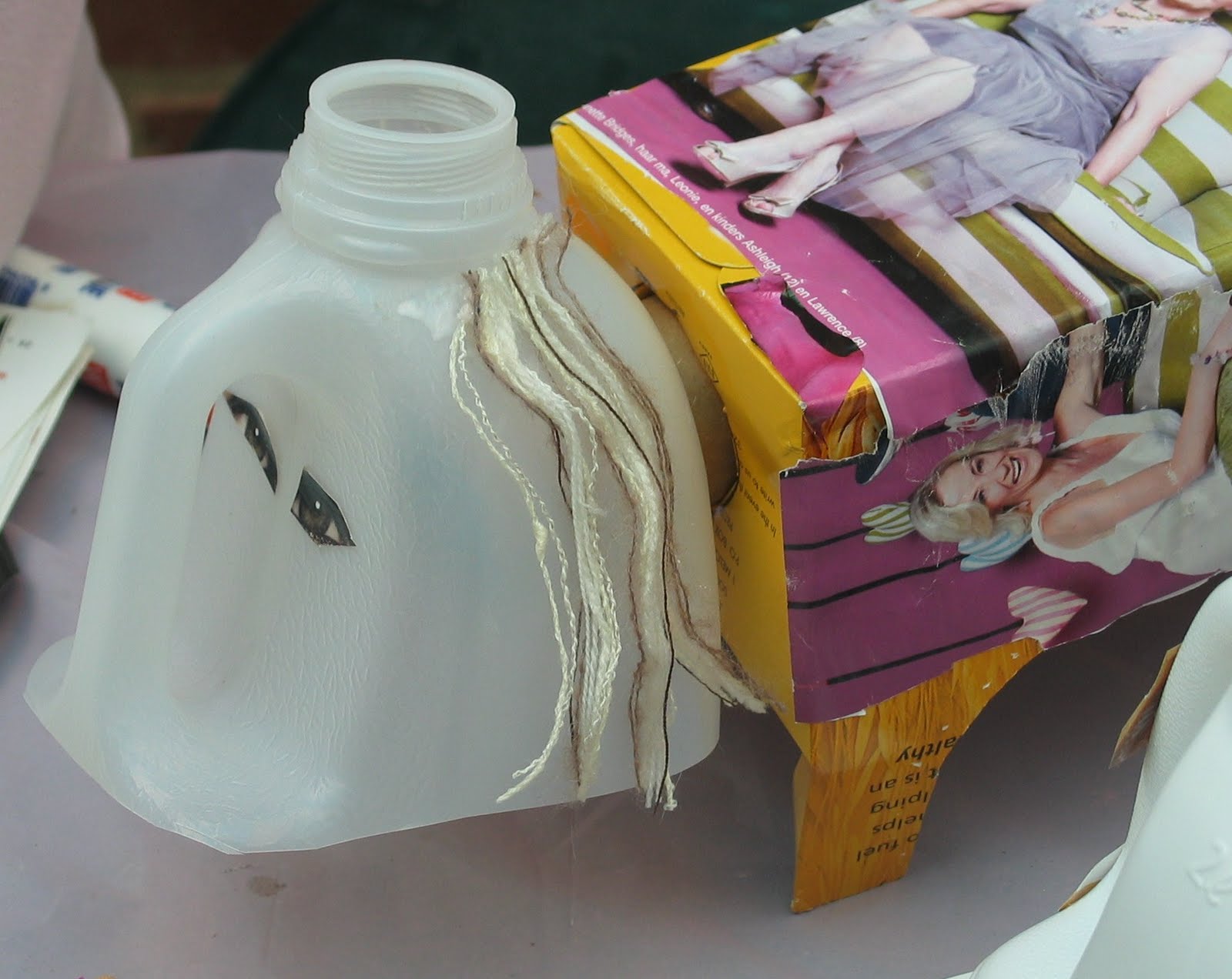
Making fantasy animals: make-believe animals, monsters or dinosaurs.

Theme:
'Unspoken fears'

Aim:
  • To explore the subject “what is scary?”
  • To develop fantasy/imagination and to express it in three dimensional terms
  • Stimulate discussion about imaginary or pretend creatures; although we know that they are not real we can make believe that they are real.  Talking about scary animals or people gives them an opportunity to speak about fears in a safe place.

Activity
Anything can be used. I used recycled material: the top of the milk bottle + handle as the head and a sturdy cardboard box was used as the body. The head and body are joined together by making a hole in the appropriate places and using a toilet roll to link the two pieces. We added string tails as well. My only cost was the glue, glitter glue and paint.


Materials:
  • Milk bottles,
  •  boxes, 
  • toilet rolls, 
  • egg boxes,
  • string, 
  • wool, 
  • fluffy material, 
  • magazines, 
  • paint, glitter glue
  • glue.


Thursday, August 25, 2011

Art Facilitation 02.7


This is a cropped example of the process of making the "family tree".
In order to protect the identity of the individual and their family I have cropped  the page.

My potato print family tree.

Theme:
Who is my family?

This next exercise is not purely an art & craft exercise. I modified it from a genogram, which is usually used by doctors, social workers and counsellors, making it a fun exercise for them.

A genogram looks a bit like a family tree. I think the children understand this explanation better and so this is why I called it a family tree. Genograms are used to show familial patterns and trends of addictions (alcohol and drugs) and abusive relationships; as well as physical problems and illnesses such as heart, cancer, diabetes etc.

Aim:        
  • Through potato prints make a basic fun ‘family tree’ which will indicate the dynamics in a similar way that a genogram would.
  • To explore and indicate the family dynamics e.g. who they live with, who they like relating to, the feelings in the family and who is deceased. In this way they discover more about who they are. In the group they can develop an appreciation for each other through discussion.
  • The discussion facilitates appreciation and understanding of how they might be going through similar situations. In this way it develops a bond and support in the group.


I will explain step by step how I managed to involve the children in documenting their family system.
Activity

  1. Draw two horizontal lines across the page, dividing the page into three in this way making a three tiered ‘graph’ showing the family: (1) children: brothers, sisters and cousins; ( 2) parents: moms, dads and aunts and uncles; and (3) grandparents.
  2.  In the middle of tier (1) make a potato print symbolizing themselves.
  3. Then print all their brothers, sisters and cousins who might be living with them, in the same row.
  4. After that move to tier (2) showing mother/father/ aunt/ uncle with whom they live.
  5. Next show in tier (3) their grandparents.             
  6. Once this is done the first tier should be dry and they can add limbs and faces. In this way they can work their way back up the tiers doing the same for the rest of their extended family.
  7. I then asked them to draw a line from them to the person they enjoy talking to (there could be more than person). This is to help them identify for themselves who they most trust.
  8. Lastly I said they could indicate if someone had died in the family by putting a cross through them.


They can decorate the family drawing with glitter glue and foam shapes.
Informal discussion can evolve into sharing what they have in common with the other members of the group, e.g. what happens in the family, who looks after them, who has to look after themselves, who has experienced loss of a parent or grandparent.

Glitter glue and potatoes.

Materials:
  • Paper, 
  • paint, 
  • potatoes, 
  • pencils
  • crayons, 
  • foamtastic shapes
  • glitter glue.


Decorations.

Thursday, August 18, 2011

Art Facilitation 2.06


Bee by girl aged 8 years.

Egg box animals

Theme:
Finding common ground in the group. (As drawing was more anxiety provoking for this group I planned the construction for them. They all participated enthusiastically and created very individual looking bees.)


Planning and creating.

Aim:
  • By using construction skills which were similar in ability bring a feeling of artistic equality within the group
  • Develop dexterity in construction.
  • Develop imagination and fantasy. 


Further construction

Activity and instructions:
Have some egg boxes prepared (cut into strips) and demonstrate: I showed them models of insects (ladybird, worm, dragonfly and bee). Encourage them to make their own creatures. It is best to construct the whole insect first and then paint as the cardboard gets soft and mushy. It becomes dissatisfying for them when their creations fall apart while under construction. Masking tape, staplers and split pins are a good option if you or the children are looking for speedy results. Once the paint is dry you can glue on the other decorations.

Materials:
  • Egg boxes, 
  • boxes, 
  • split pins, 
  • masking tape, 
  • glue, stapler, 
  • pom-poms, 
  • eyes, 
  • wire, 
  • pipe cleaners,
  • beads, 
  • paint, 
  • pencils,
  • pastels. 


Bee by boy aged 12 year.

Tuesday, August 16, 2011

Art Facilitation 02.5

Example 1 boy age 11 years old


A mixed media / collage: my fantasy tree-house

Theme:

‘The home or space where I feel safe’
Exploring which spaces or places feel safe and who would they like to have close to them in these places.

Aim:
  • Is to explore and identify the ‘safe’ people in their lives; with whom they feel comfortable and making space for them.
  • Develop imagination and fantasy.
  • Have exposure to different artistic materials by making a mixed-media picture; using pencil, pastel, ink, paint and collage thereby continuing to develop their artistic ability.

Activity
Discussion: talk about the habitats where different animals live e.g., forest; what it looks like and what animals live in the forest. Then get them to imagine a magic forest and where or what their special place was. They can imagine living in a magic tree or in a magic tree house. Once they have their imaginary living area they can choose anyone to live with them: animals, friends, teachers, mom, dad, brothers, and sisters, whoever they want. They can also decide who they don’t want living with them. You can ask: “what happens in your magic home? What do you feel?”

Materials:
  • Leaves – pre-collected
  • Paper
  • Ink
  • Pencils
  • Glue 
  • Paint 
  • Oil or chalk pastels
  • Magazines for collage


Example 2 boy age 12 years old; pre-plan


Instructions:
The children can design their tree-houses using pencil and pastel, thinking of the people and objects they want to include with them. I gave the children the option of using paper from magazines or tracing the leaves to cut out and collage or collaging the leaves straight on to the tree. They could find people and animals from magazines to paste in or draw as the chosen people. These are the only guide lines I gave my children as I was happy for them to design and construct it how they wanted to, using the materials however they wanted; this encourages them to think for themselves.      


Example 3 girls age 9 years old


Here is a tip:
Sometimes things don’t go according to plan.
Try not to worry about it and go with the flow.
These types of exercises often have a life of their own;
I believe that people will normally create the experiences they most need.
 Just stay attentive and notice what they need from your leadership.

In this particular group of mine they wanted to rather paint and draw with minimal collaging. Paint is a wonderful messy medium which allows emotions to be expressed. It is better to accept that things are not going according to plan and that it will turn out for the best anyway.

This exercise was adapted from the book: Art therapy for Groups (a handbook of themes, games and exercises) by Marian Liebmann (1986).


Saturday, August 13, 2011

Art Facilitation 02.4


Making masks

Theme: ‘My feelings’
This gives opportunity to explore feelings in the individual and the family.


Aim:
  • To informally explore and identify feelings: sad, happy, angry, fear, and surprise.
  • To develop a vocabulary, visually and verbally (feeling words and feeling colours), for feelings through discussion.
  • To have an opportunity to express feelings by making a mask; showing emotion through colour and line.


Activity
  • You can give each child a mirror and ask them to pull faces at themselves, making the different expressions of feelings such as sad, happy, angry, fear and surprise. You can also ask them “what does your mother/ brother/ father etc. look like when they are feeling (fill in the gap)…?”
  • Discussion can also involve other questions like: “what happens when (fill in the gap)….what do you feel?”
  • Using paper plates, they can draw a face, theirs of someone else’s. They can fill the colour in with paint or collage or oil / chalk pastels    


Materials:
  • paper plates
  • pencils
  • paint 
  • oil or chalk pastels
  • magazines for collage
  • string


Instructions:
You can prepare an example of the different facial expressions beforehand to inspire the children but the main aim is to get them expressing themselves. This is why I like to give them mirrors. Those who are developing an appreciation for realism might prefer to have some reference from which to work. The wide range of materials gives them variety and choice to express freely and uniquely.

When drawing the face the eyes need to be positioned according to the child’s eye position. After the face has been finished eye holes need to be cut, holes at the temples are cut for attaching the string which is tied behind. A third string can be attached from the top at the forehead for more stability. A hole can be cut for the mouth too if so desired.

When the masks are finished they can be used in role play or free play. 


Wednesday, August 10, 2011

Art Facilitation 02.3


Paper bag Puppets  


As I mentioned before, I developed the themes appropriate to their reality. The general theme for this term: the roles we play and the first day’s theme: who am I the cultural context e.g. in my family and school? The age range from 8 - 12 years old.

Aim:
·         To explore and appreciate their roles in the family, school and extra-murals; thus discovering more about their identity, individually and in the group.
·         Make a puppet out of recycled materials, showing who they are.
·         Through having fun, develop skill at using art materials for emotional expression, building self-esteem & self-confidence                                                        

                               
Activity
· Discuss examples of roles – mother, father, grandparents, siblings etc., and how the different roles play out in family, school and community. They can role-play aspects of their roles within the group.
·  After the puppets are made they can also use the puppets for role play.

Materials:
Recycled materials keeps the cost down and fosters creative thinking:
·         (Paper) sugar bags turned inside out,
·         glue,
·         crayons,
·         wool,
·         bottle tops,
·         buttons,
·         material,
·         feathers,
·         felt etc.


Instructions:
The children can do preliminary drawings to plan the puppet or they can engage in puppet making spontaneously. Basic drawing, cutting and gluing skills are needed and/or developed. Adult help is minimal. Allow the children to express their unique individuality by planning and choosing their own materials.
The face is drawn on the bottom of the paper bag, which can flap up and down when held upside-down. (See photo). The mouth is drawn over the flap so that it can be manipulated to “speak”. The rest is up to their imaginations.